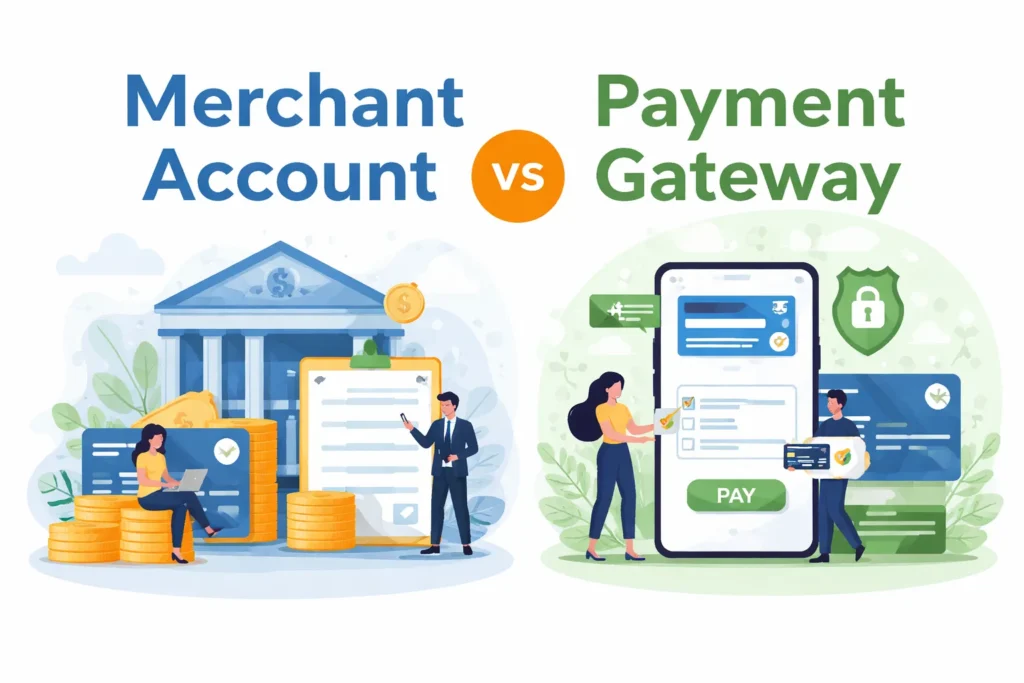
Merchant account vs payment gateway confuses many U.S. businesses just starting with online payment processing. Think of it this way: one holds your money safely, while the other grabs customer card details securely during checkout. This guide breaks it down simply so businesses can pick the right payment processing solutions USA without getting overwhelmed.
What is a Merchant Account
A merchant account acts like a special business bank account for handling credit card payments. Banks or merchant services providers set it up to receive funds from customer transactions after everything checks out. Funds sit there temporarily before moving to your regular bank, usually in 1-3 days.
Without this account, businesses cannot accept cards because no place exists to deposit those payments. It also covers risks like fraud or chargebacks. Merchant account vs payment gateway starts here—payment gateways send data, but only merchant accounts store the actual money.
What is a Payment Gateway
Payment gateways serve as the front door for customer payments online. They capture card info at checkout, encrypt it, and send it through for approval. Popular ones integrate with sites like Shopify or WooCommerce for smooth ecommerce payment gateway experiences.
This tech focuses on security and speed, not holding funds. Customers see the gateway as that secure checkout page. In merchant account vs payment gateway talks, gateways handle the tech handoff first.
Merchant Account vs Payment Gateway
Merchant account vs payment gateway boils down to roles: one manages funds and risk, the other transmits data securely. Businesses often need both working together for full credit card processing services. Here’s a quick comparison table.
| Feature | Merchant Account | Payment Gateway |
| Main Job | Holds and settles funds | Encrypts and sends payment data |
| Provided By | Banks or processors | Tech companies like Stripe |
| Cost | Fees per sale + monthly | Setup + transaction fees |
| Risk Handling | Chargebacks, fraud | None—passes to processor |
| Example Use | Deposits $100 sale to your bank | Grabs card number at buy button |
It means understanding this split prevents payment fails. Many bundled secure payment processing options hide the difference, but knowing helps cut costs.
Difference Between Merchant Account and Payment Gateway
The core difference between merchant account and payment gateway lies in the payment flow. Gateways kick off the process by securing card details and routing them to processors. Merchant account vs payment gateway highlights how accounts then verify and deposit those funds.
Gateways shine in tech like tokenization for secure payment processing. Accounts focus on banking rules and reserves for disputes. Small U.S. shops often pick all-in-one payment gateway providers in USA to skip setup hassles.
How Payment Gateways Work
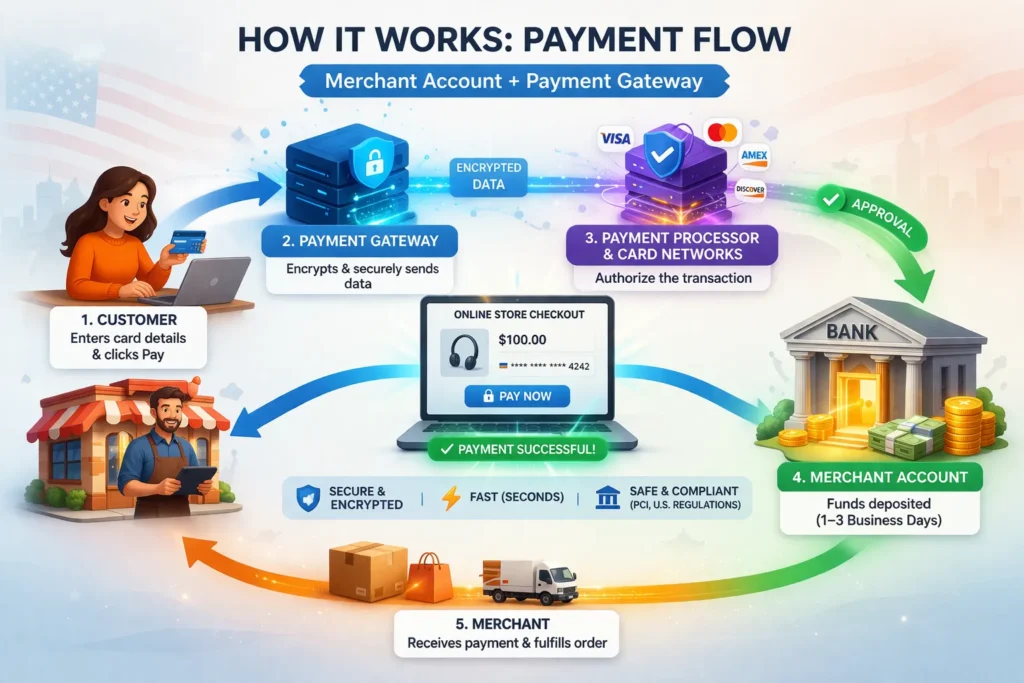
How payment gateways work follows a clear chain every time someone pays online. Customer enters card info on your site. Gateway encrypts it instantly and pings the processor.
Processor checks with card networks like Visa. Approval zips back through the payment gateway, showing “Payment successful.” Funds land in the merchant account later. This setup powers most online payment processing today.
Visualize it step-by-step:
- Customer clicks pay.
- Payment gateway scrambles data.
- Banks approve or deny in seconds.
- Merchant gets notified to ship goods.
Why U.S. Businesses Need Both
Merchant account vs payment gateway matters most for U.S. firms because laws demand separation. PCI compliance protects data via gateways, while accounts handle FDIC-insured funds. Scaling ecommerce payment gateway setups? Match high-volume sales with robust accounts.
Startups love bundled merchant services provider plans from Stripe or Square. They bundle merchant account vs payment gateway into one fee. Larger stores separate for better rates on credit card processing services.
Choosing Payment Processing Solutions USA
Top payment processing solutions USA blend both seamlessly. Look for low fees, fast payouts, and fraud tools.
Compare based on volume:
- Low sales: All-in-one like PayPal.
- High volume: Separate merchant account for negotiation.
Merchant account vs payment gateway decisions save 20-30% on fees yearly. Test integrations first.
Secure Payment Processing Tips
Secure payment processing starts with PCI Level 1 gateways. They use 256-bit encryption and never store full card data. Pair with merchant accounts offering 3D Secure for extra verification.
U.S. regs like FTC rules push tokenization. This swaps card numbers for codes. Results? Fewer breaches, happier customers.
Merchant account vs payment gateway security differs—gateways block hacks upfront, accounts insure the backend.
Costs and Providers Breakdown
Merchant account vs payment gateway costs vary wildly. Gateways charge $10-30 monthly plus 0.5-2% per sale. Accounts add 1-3% interchange plus $10-20 fees.
| Provider Type | Setup Fee | Monthly | Per Transaction |
| Bundled (Square) | $0 | $0 | 2.6% + 10¢ |
| Separate Gateway | $50 | $20 | 1% + 30¢ |
| High-Volume Account | $100 | $15 | Negotiable |
Conclusion:
Pick payment gateway providers in the USA with no lock-ins. Merchant services providers often waive setups for volume. Merchant account vs payment gateway both contribute like both gateway encrypts, account secures funds. Start PCI compliant now.
Frequently Asked Questions
What is a merchant account exactly?
A merchant account holds funds from card sales before sending them to your bank, managed by a financial institution. It protects against fraud and ensures compliance. U.S. businesses use it alongside online payment processing for reliable deposits, typically settling in 24-48 hours.
Merchant account vs payment gateway—which do I need first?
Start with a payment gateway for checkout, but pair it with a merchant account for fund holding. Most credit card processing services bundle them. Merchant account vs payment gateway requires both for full flow—gateway sends data, account receives money.
What’s the main difference between merchant account and payment gateway?
Difference between merchant account and payment gateway is function: gateways encrypt and transmit, accounts store and settle. Gateways focus on tech security, accounts on banking. This split powers ecommerce payment gateway systems safely.
How payment gateways work in simple terms?
How payment gateways work: Customer pays, data encrypts, routes to processor, approval returns fast. Integrates with sites for seamless secure payment processing. No funds held—hands off to merchant account.
Best payment processing solutions USA for small businesses?
Payment processing solutions USA like Stripe or Square offer easy online payment processing with no setup fees. They handle merchant account vs payment gateway internally. Great for startups under $10K monthly sales.
Which credit card processing services are cheapest?
Credit card processing services from Square start at 2.6% + 10¢, no monthly fee. Compare merchant services providers for volume discounts. Avoid high setups unless scaling fast.
Top ecommerce payment gateway options?
Ecommerce payment gateway leaders: Stripe, PayPal, A Positive Merchant Consulting LLC. They support carts like Shopify with secure payment processing. Check integrations first for your platform.
Reliable merchant services providers in USA?
Merchant services providers like FIS or Worldpay offer custom merchant account vs payment gateway setups. Ideal for high-risk or large volumes. Look for 24/7 support.
Best payment gateway providers in USA for security?
Payment gateway providers in USA with top security: A Positive Merchant Consulting LLC, 2Checkout. Use tokenization and PCI DSS. Pairs well with any merchant account for full protection.
Does every business need secure payment processing?
Yes, secure payment processing prevents breaches under U.S. laws.