How to accept online payments—this is where everything starts now. Not marketing, not ads, not even your product. Because if a customer can’t pay you easily, nothing else really matters.
Think about it. Someone is ready to buy. They’ve made the decision. The only thing left is payment. If that part feels confusing, slow, or limited… they leave.
So understanding how to accept online payments is not a technical step. It’s a business survival step in 2026.
First, Understand What’s Really Happening When Someone Pays You
Before jumping into tools and platforms, it helps to see what’s actually going on behind the scenes.
A customer clicks “Pay Now.”
Their money moves from their card, wallet, or bank…
Through a system…
And lands in your account.
That “system” is what you’re setting up when learning how to accept online payments.
And the goal is simple:
Make that process feel instant, safe, and effortless.
Why Small Businesses Can’t Ignore This Anymore
Not long ago, cash worked. Bank transfers worked. Even manual invoices worked.
Now? People expect speed.
Users crave simplicity.
Their demand for speed is absolute.
Expectations center on a completely frictionless flow.
If your business can accept payments online, you remove all that friction.
That’s when things change:
- Customers don’t hesitate
- Payments don’t get delayed
- Sales don’t fall through
This is why more businesses are moving toward digital payments for business without even thinking twice.
The Different Ways People Will Pay You
Here’s the reality—your customers won’t all pay the same way. Some prefer cards or apps. Some want flexibility.
So when thinking about how to accept online payments, it’s not about choosing one method. It’s about offering the right mix.
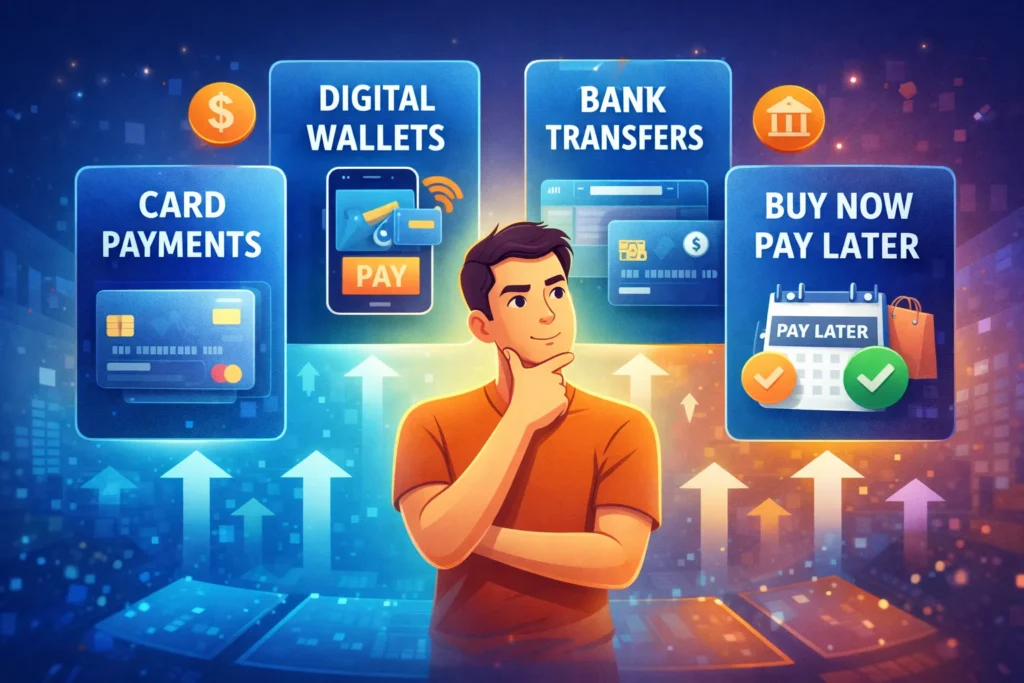
| Payment Type | What It Feels Like for Customer | Where It Works Best |
| Card Payments | Fast, familiar | Online stores, services |
| Digital Wallets | One-tap checkout | Mobile users |
| Bank Transfers | Direct and simple | Larger payments |
| Buy Now Pay Later | Flexible | Expensive items |
| Payment Links | Quick and easy | Freelancers, services |
Each option helps you accept electronic payments in a way that fits different customer habits.
Let’s Walk Through Setup Like a Real Business Would
Now imagine setting this up from scratch.
Step 1: Choose How You Want to Get Paid
This is the first real decision.
Do you want customers to:
- Pay directly on your website?
- Click a payment link?
- Scan something and pay?
This choice defines how you’ll take payments online.
Most small businesses start simple—payment links or checkout pages—and then expand.
Step 2: Pick a Payment Processor
This is the middle layer. The one that actually handles money.
Think of it like this:
You don’t manually collect payments. The processor does it for you.
This is what allows you to accept card payments small business without dealing with banks directly.
And once this is set up, everything becomes automatic.
Step 3: Connect It to Where You Sell
Selling through a website? Add checkout.
Selling through messages? Use payment links.
Selling in person? Use QR or POS.
This is where how to accept digital payments becomes practical.
It’s not about tools—it’s about matching how your customers already buy.
Step 4: Make It Feel Safe
Here’s something most people overlook.
Customers don’t just look at price.
They look at trust.
If your checkout looks unsafe, they won’t continue.
So when setting up how to accept online payments, security isn’t optional:
- HTTPS (secure website)
- Trusted payment logos
- Clear confirmation after payment
That feeling of safety is what completes the sale.
Step 5: Give People Options
While many stick to cards, a growing number favor wallets, and nearly everyone demands flexibility.
If you only offer one option, you lose others.
That’s why businesses that accept electronic payments in multiple ways always perform better.
What Actually Works Best for Small Businesses
This is where most people overthink.
There’s no single “perfect” setup.
But there is a practical one.
The best way to accept payments for small business usually looks like this:
- Cards for reliability
- Wallets for speed
- Payment links for flexibility
That combination covers almost every customer type.
And once this is in place, small business payment processing becomes something that runs quietly in the background.
Selling to Customers Directly? Keep It Simple
When thinking about how to accept b2c payments, simplicity wins every time.
Customers don’t want steps.
They want flow.
Click → Pay → Done
That’s it.
The fewer decisions they make, the more likely they are to complete the payment.
A Small but Important Shift in 2026
Here’s what’s changing right now.
People don’t just want to pay.
They want to pay their way.
That means:
- One-click payments
- Saved cards
- Instant confirmation
- Flexible payment options
Businesses that understand this don’t struggle with how to accept online payments—they use it as an advantage.
Where Most Small Businesses Get Stuck
Not in setup.
Not in tools.
But in hesitation.
- Waiting too long to set it up
- Overcomplicating the process
- Offering too few payment options
Once those are fixed, everything becomes smoother.
And suddenly, accept payments online isn’t a task—it’s just how business works.
Conclusion:
At the end of the day, this isn’t about technology. It’s about removing friction between you and your customer. That’s what how to accept online payments really means. Make it easy to pay. Make it feel safe. Make it fast. Do that, and everything else—sales, growth, trust—starts to follow naturally.
Frequently Asked Questions
What is the easiest way to start accepting payments online?
The simplest way is using payment links or platforms like PayPal or Stripe, allowing quick setup without needing a full website or complex integration for beginners.
How can a small business accept credit card payments online?
By signing up with a payment processor, enabling card payments, and integrating checkout or links, businesses can easily accept credit card payments securely online.
Do small businesses need a website to accept payments online?
No, payments can be accepted through links, QR codes, or apps, making it possible to receive money without having a website at all.
What is the best way to accept payments for small business?
A mix of card payments, digital wallets, and payment links works best, giving flexibility and covering most customer preferences in one setup.
Are online payments safe for small businesses?
Yes, when using secure processors with encryption, SSL, and compliance standards, online payments are safe and widely trusted by customers globally.
How fast do online payments reach a business account?
Most processors transfer funds within one to three business days, while some offer instant payouts depending on the platform and account setup.
Can businesses accept recurring or subscription payments?
Yes, many payment processors support recurring billing, making it easy to charge customers automatically for subscriptions or ongoing services.
What are typical payment processing fees?
Fees usually include a percentage per transaction plus a fixed fee, which varies depending on the provider and payment method used.
How do businesses accept B2C payments easily?
By offering simple checkout, multiple payment options, and fast confirmation, businesses make it easy for customers to pay without friction.
What payment methods should small businesses offer in 2026?
Credit cards, digital wallets, bank transfers, and flexible payment options like buy-now-pay-later are essential to meet modern customer expectations.