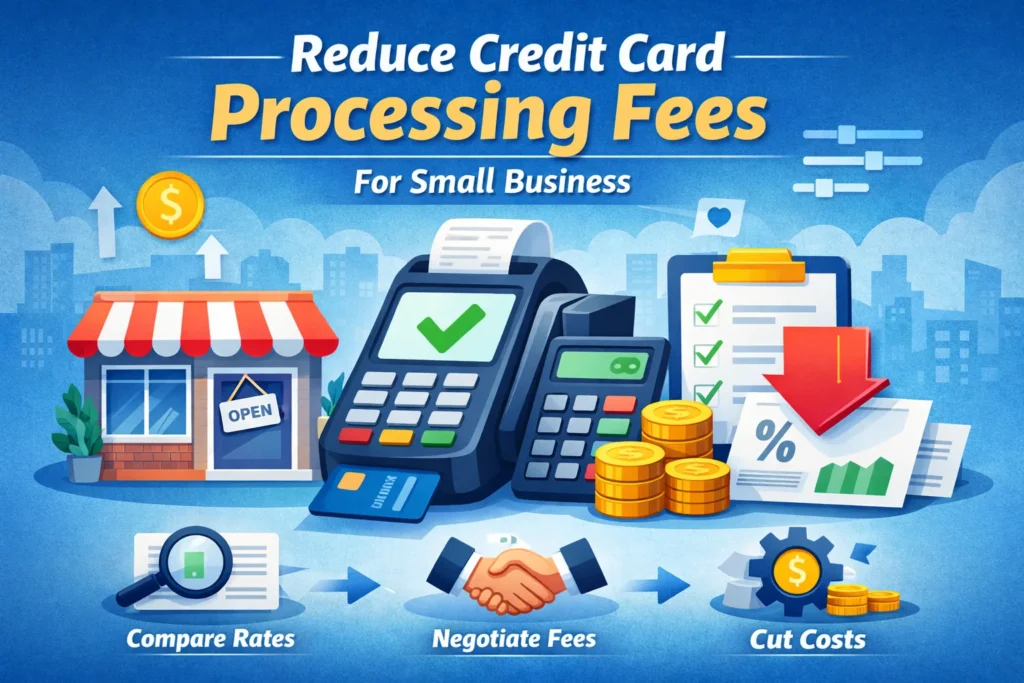
Reduce credit card processing fees, that’s what every small business owner wants, right? Every time a customer swipes their card, some of that hard-earned money disappears as credit card fees. For small businesses, these little percentages add up fast. But the good news is, there are ways to take control and keep more money in your pocket. Let’s break it down step by step.
What Are Credit Card Fees Anyway?
If you’ve ever looked at your monthly statement and thought, “Where is all my money going?”,this is why. Credit card merchant fees aren’t just one thing. They usually come in three parts:
- Interchange fees: This goes straight to the card networks like Visa or MasterCard.
- Assessment fees: Small percentage for the network to handle transactions.
- Processor markup: What your payment processor adds on top for their services.
Here’s a simple example for a $100 sale:
| Fee Type | Typical Cost | What It Means |
| Interchange Fee | 1.5–2.9% | Paid to card networks per transaction |
| Assessment Fee | 0.1–0.13% | Network’s own maintenance fee |
| Processor Markup | 0.25–0.5% | Profit margin for merchant services |
| Total Credit Card Fee | 1.85–3.5% | What small businesses usually pay per transaction |
Knowing this is the first step to reduce credit card processing fees. Once you know what you’re paying, you can figure out how to spend less.
Pick the Right Merchant Service
Not all merchant services are created equal. Choosing the least expensive merchant services can cut your fees without changing anything for your customers. Here’s what to look for:
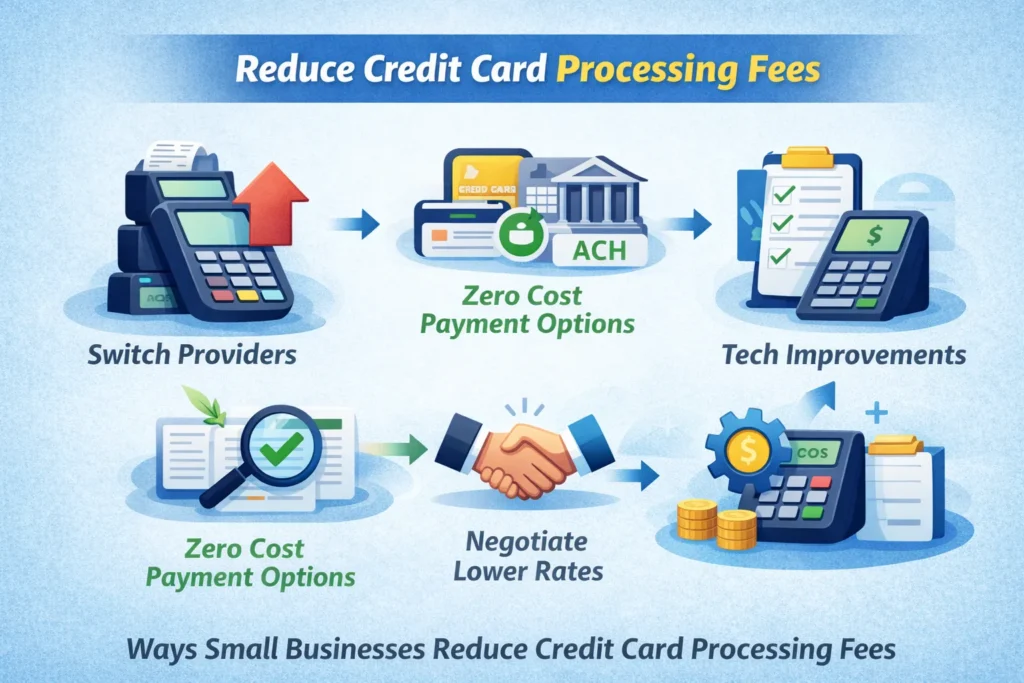
- Compare multiple providers, look at both flat-rate and interchange-plus pricing.
- Check for hidden monthly or statement fees.
- Ask other small business owners about their experiences with small business credit card processing.
Switching to the right provider can shave off 0.5–1% from your fees. It might not sound huge, but over hundreds of transactions, it adds up.
How Customers Pay Matters
Believe it or not, the way customers pay affects your credit card processing fee. Some tips:
- Encourage debit or ACH payments, they usually cost less than credit cards.
- Look for zero cost credit card processing options for in-person sales.
- Offer mobile or contactless payments, they often have lower rates.
By adjusting payment methods, you can reduce credit card processing cost without making things harder for your customers.
Don’t Be Afraid to Negotiate
Many businesses think fees are fixed—but they’re not. You can negotiate to lower your credit card merchant fees. Here’s how:
- Ask your processor for a detailed fee breakdown.
- If your monthly volume is growing, ask for a volume discount.
- Keep an eye on contract terms to avoid automatic rate increases.
Even a small discount per transaction can save hundreds or even thousands a year.
Offset Fees Without Losing Customers
Sometimes, completely eliminating fees isn’t realistic. But you can offset them smartly:
- Add a small convenience fee on credit card transactions (legal in most places).
- Give discounts for cash payments.
- Include fees in pricing and be transparent with customers.
These moves let your business reduce credit card processing fees without upsetting your customers
Use Technology to Your Advantage
Tech can make a big difference in lowering credit card fees for merchants:
- Modern POS systems can automatically pick lower-cost processing routes.
- Recurring billing platforms usually offer cheaper rates than standard merchant accounts.
- Online payment gateways can optimize networks to save you money.
Smart tech setups make every transaction cheaper and easier to manage.
Track Your Fees
If you’re serious about saving, you need to monitor your small business credit card processing:
- Check monthly statements for errors or surprises.
- Track which payment types cost the most.
- Identify patterns so you can switch to lower-cost options.
Tracking consistently ensures you reduce credit card processing fees over time, not just once.
Common Myths About Credit Card Fees
- Myth: Cheapest processor is always best. Truth: Support and reliability matter too.
- Myth: You can’t negotiate fees. Truth: Most processors will lower fees if you ask.
- Myth: Customers hate surcharges. Truth: Transparency keeps trust intact.
Knowing the facts helps you make smarter moves to reduce credit card processing fees.
Conclusion:
Pick the right merchant service for your needs. Encourage low-cost payment methods.
Negotiate fees whenever possible. Track your fees and adjust regularly. Following these steps gives small businesses a real chance to reduce credit card processing fees and keep profits where they belong.
Frequently Asked Questions
How can small businesses reduce credit card processing fees effectively?
Small businesses reduce credit card processing fees by choosing low-cost providers and pushing chip taps. Negotiate rates yearly. Tech adds data for extra savings.
Can small businesses add credit card fees to customers legally?
Yes, most states let small businesses pass credit card fees via 4% surcharges. Post clear notices. Keeps customers happy.
Are there zero cost credit card processing options available?
Yes, zero cost credit card processing uses surcharging tools to shift credit card processing fee to buyers.
Do credit card fees differ by card type?
Yes, credit card fees hit higher on rewards cards at 2.5-3%. Debit stays low at 1-1.8%.
What’s the difference between flat-rate and interchange-plus pricing?
Flat-rate uses one easy percent. Interchange-plus splits fees to reduce credit card processing fees by 20-40%.
How often should credit card processing fees be reviewed?
Review credit card processing fees monthly for errors. Quarterly for deals. Annually to switch and save.
Can switching processors reduce credit card processing fees significantly?
Switching cuts credit card processing fees 0.5-1% per sale. Drops hidden costs. Test new ones quickly.
Do mobile payments affect credit card processing fees?
Mobile taps lower credit card processing fees to 1.5%. Faster for all. Promote them now.
Are small businesses overpaying on credit card fees?
Many overpay credit card fees by 10-20%. Audit statements. Negotiate to fix it.
How does technology help reduce credit card processing fees?
Tech finds cheap routes and adds data to reduce credit card processing fees. Tracks are easy.