Reduce payment delays is something every Maryland business ends up dealing with at some point, and honestly, it’s usually the silent reason cash flow feels tight even when sales look good on paper.
Because here’s what really happens in most businesses: work gets delivered, invoices go out, and then money just… takes its time. That gap between work done and money received is where everything starts slowing down.
And that’s exactly why learning how to reduce payment delays changes everything. Not just billing, but overall stability, planning, and day-to-day operations.
Once systems are set properly, reduce delays stops being a constant struggle and becomes something that naturally improves over time.
Why Payment Delays Keep Happening in Real Businesses
Most payment delay issues don’t come from one big mistake. It’s usually a mix of small things that build up.
Like:
- Invoices sent manually and sometimes forgotten
- Customers not clearly seeing due dates
- No proper invoice payment management system in place
- Follow-ups happening too late or not at all
- Weak or missing payment processing solutions
- No real automated payment processing in the background
So what happens is simple—money is expected, but not collected on time. And that’s how delays quietly become normal.
To really reduce delays, the system itself has to change, not just reminders.
The Simplest Shift: Stop Waiting, Start Automating
One of the biggest improvements comes when businesses stop relying on manual payment behavior.
When you take recurring payments online, you’re basically removing the “remember to pay” step completely.
Instead of waiting every month or every invoice:
- Payments are collected automatically
- No chasing required
- No waiting for customer action every time
This alone can strongly reduce delays because the process is no longer dependent on memory or timing.
And when this is combined with recurring billing solutions, payments just keep flowing in a predictable pattern.
Manual Systems Vs Automated Systems (This is Where Delays Start Changing)
| Situation | What actually happens | Result |
| Manual invoicing | Everything depends on follow-ups | High payment delay |
| Basic digital billing | Some improvement but still manual effort | Medium delays |
| Payment processing solutions | Faster and smoother transactions | Better timing |
| Automated payment processing | System handles reminders + tracking | Strong reduce payment delays effect |
| Recurring billing solutions | Payments happen automatically | Very low delays |
The more automated it gets, the less room there is for delay to even happen.
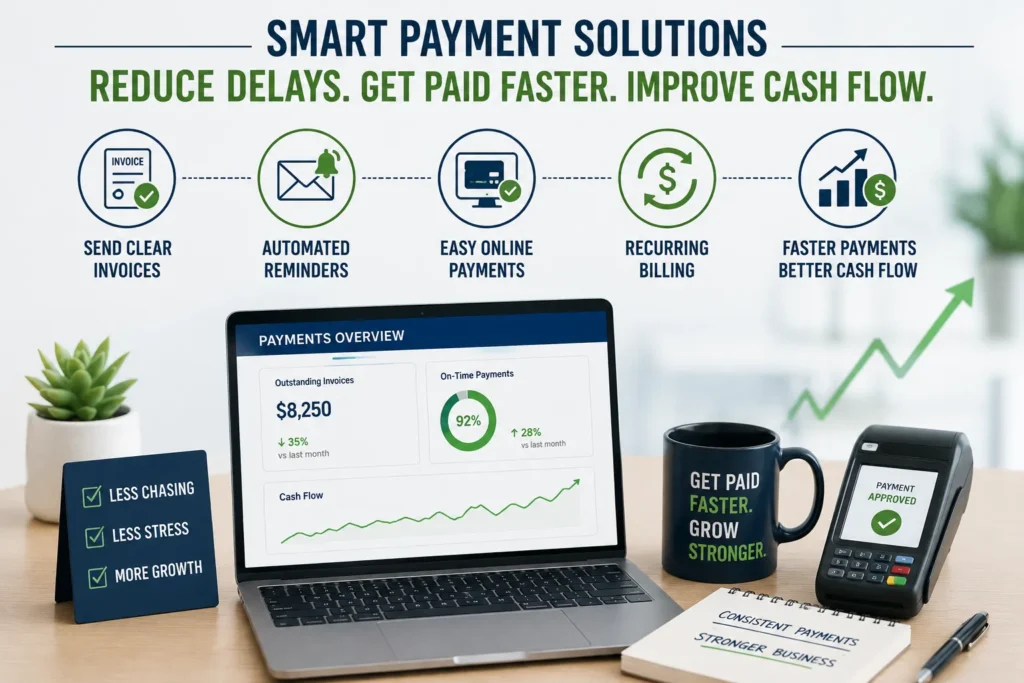
Why Invoices Alone don’t Get Payments Moving
A lot of businesses think sending invoices means payment will follow quickly.
But in reality, that’s where payment delay usually starts.
If an invoice:
- Is unclear
- Has no strong due date visibility
- Doesn’t include easy payment options
Then customers delay without even thinking about it.
That’s why strong invoice payment management matters so much. It removes confusion.
Simple rule: if the customer has to think before paying, delay usually happens.
Make Paying so Easy that Delay doesn’t Even Make Sense
To really reduce payment delays, the payment process has to feel effortless.
Not “go log in and transfer” effort… more like:
- Click and pay
- Open link and complete
- Done in seconds
When payment processing solutions are set up properly, that’s exactly what happens.
And once payment becomes that easy, people don’t postpone it as often.
Reminders Actually Matter More Than Most People Think
Here’s the reality: most delays are not refusal, they’re forgetfulness.
So reminders play a huge role in helping reduce delays.
A proper flow looks like:
- Reminder before due date (so it stays in mind)
- Reminder on due date (so it gets actioned)
- Follow-up after due date (so it doesn’t disappear)
When this runs automatically through automated payment processing, it becomes consistent and reliable.
No awkward chasing, just structured communication.
Cash Flow Improves When Money Starts Moving Faster
Cash flow is basically timing.
Even profitable businesses struggle when money comes late.
But when systems are built to reduce payment delays, cash starts flowing in regularly instead of randomly.
That’s where:
- Bills get paid on time
- Vendors stay happy
- Planning becomes easier
- Stress goes down
And this is where improve cash flow actually becomes real in day-to-day operations.
The Hidden Mistakes that Keep Delays Alive
Most businesses don’t realize they are causing delays themselves.
Common ones:
- Sending invoices late
- No reminder system
- Ignoring overdue payments too long
- Not offering online payment options
- Tracking everything manually in spreadsheets
Fixing even a few of these can significantly reduce payment delays without needing big investments.
The Real Shift: From Chasing Payments to Systems Doing It for You
The biggest change happens when the mindset shifts.
Instead of thinking:
where is this payment
It becomes:
The system will handle it
With automated payment processing, payment processing solutions, and invoice payment management, everything starts running in the background.
That’s when reduce payment delays stops being a constant effort and becomes a built-in result.
Conclusion:
At the end of the day, businesses that manage to reduce payment delays are not the ones pushing harder for payments—they’re the ones building systems that naturally collect them faster.
Once payments move into structured systems like take recurring payments online, recurring billing solutions, and automation tools, everything becomes smoother.
Cash flow becomes predictable, operations feel lighter, and the business stops depending on delayed money to survive the month.
And that’s really the goal—less waiting, less chasing, and a system that quietly works in the background to reduce payment delays every single cycle.
Frequently Asked Questions
Why is it so important to reduce payment delays in a business?
Because when payments come late, everything else slows down with it. Bills get harder to manage, cash flow becomes unstable, and even daily operations start feeling pressure even if sales are strong.
What is the fastest way to reduce payment delays in real business situations?
The fastest way is to remove manual steps. Adding online payment links, automated reminders, and clear due dates instantly reduces confusion and speeds up payments without needing extra effort from customers.
How does automated payment processing actually help reduce payment delays?
It works in the background without needing human follow-ups. Invoices go out on time, reminders are sent automatically, and overdue payments are tracked, so nothing gets missed or forgotten.
Do recurring billing solutions really make a difference in payment timing?
Yes, because payments are collected automatically on fixed dates. There is no waiting for customers to take action every time, which removes one of the biggest reasons delays happen in the first place.
Why do customers delay payments even when they agree to pay?
Most of the time it’s not refusal. It’s forgetfulness, busy schedules, or unclear payment instructions. If the process is not easy, people naturally push it later.
How does invoice clarity impact payment speed?
Clear invoices remove confusion. When customers clearly see what to pay, when to pay, and how to pay, they don’t need to ask questions, which directly speeds up the payment process.
Can small businesses also reduce payment delays without expensive tools?
Yes, even simple tools like digital invoices, payment links, and scheduled reminders can make a big difference. It’s more about structure than budget.
How do payment processing solutions improve cash flow?
They make payments faster and easier to complete. When money comes in quicker and more consistently, cash flow becomes stable instead of unpredictable.
What is the biggest mistake businesses make when trying to reduce payment delays?
The biggest mistake is relying only on manual follow-ups. Sending invoices is not enough anymore; without automation and reminders, delays continue happening again and again.
What happens long-term when a business successfully reduces payment delays?
Everything becomes smoother. Cash flow becomes predictable, stress reduces, vendor payments stay on time, and the business can plan growth without constantly waiting on overdue payments.