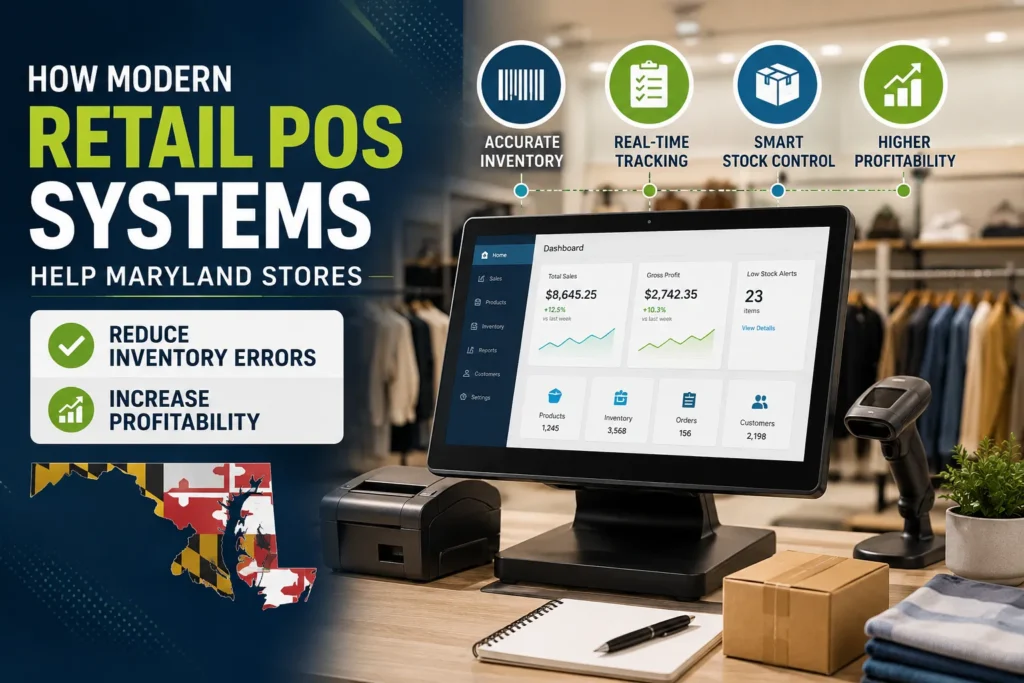
A retail POS system has become the central control point of modern retail stores, especially for businesses in Maryland that are trying to stay competitive, keep stock accurate, and protect profit margins in a fast-moving market.
This is not just a tool for billing anymore. It is the system that quietly runs the entire store in the background. Every sale, every product movement, every stock update, and every report flows through it without needing manual effort.
And that shift changes everything about how retail stores operate day to day.
How a Retail POS System Changes the Way a Store Actually Runs
In traditional setups, retail work often depends on people remembering things, writing things down, or updating spreadsheets after the fact.
That is where mistakes start.
A point of sale for retail removes that dependency completely. It keeps everything connected in real time.
- A product is sold, and stock updates instantly
- A return happens, and inventory adjusts automatically
- A new shipment comes in, and records update immediately
- A price change is reflected across the system without delay
So instead of information moving slowly through people, it moves instantly through the system. That alone reduces a large portion of inventory confusion.
Where Inventory Errors Actually Come from in Retail Stores
Inventory mistakes usually do not happen in one big moment. They build up quietly.
- A staff member forgets to update a stock count
- A product is scanned incorrectly
- A manual entry is typed wrong
- A delivery is recorded late or partially
- A mismatch goes unnoticed for days or weeks
Over time, these small gaps grow into real problems like missing stock, wrong ordering, and lost sales.
A retail POS system steps in by removing most of these manual touchpoints entirely.
Real-time Tracking that Keeps Everything Aligned
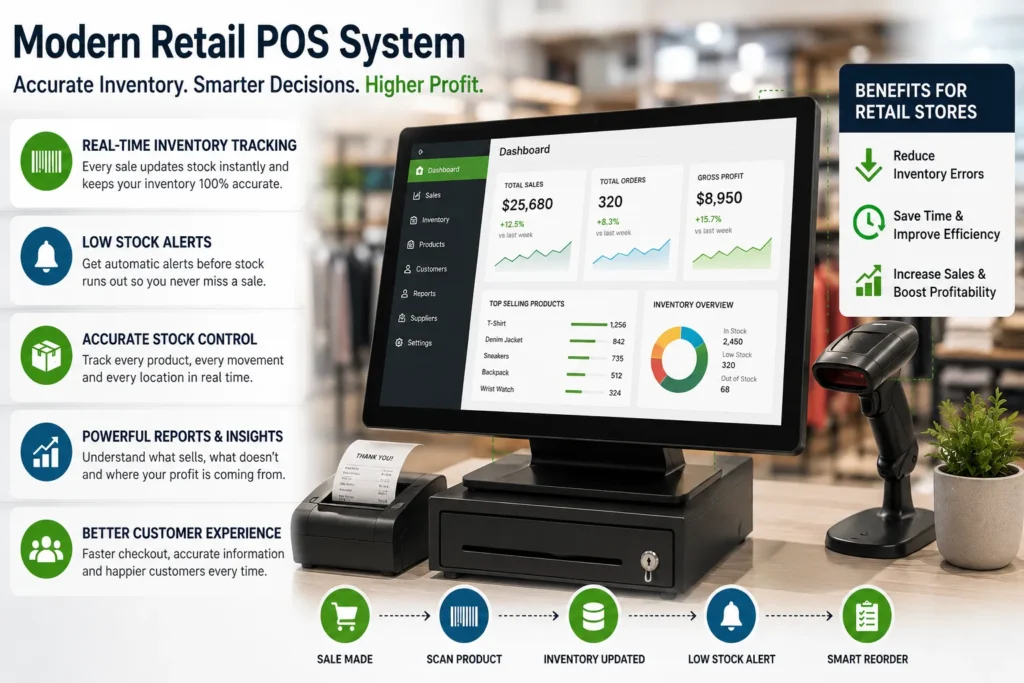
One of the strongest advantages of an inventory management software for retail is real-time tracking.
Every single sale immediately updates inventory. There is no waiting period, no end-of-day correction, and no guessing.
What this really means in a store:
- Staff always see accurate stock numbers
- Customers are not promised unavailable items
- Reordering becomes based on real demand
- Stock planning becomes more predictable
Instead of reacting to problems later, the system prevents them from building up in the first place.
Barcode Scanning that Removes Simple but Costly Mistakes
A lot of inventory errors come from simple typing issues or wrong product selection.
A retail POS system removes that risk through barcode scanning.
- One scan identifies the exact product
- No manual typing required
- No confusion between similar items
- No duplicate or incorrect entries
What used to depend on attention and memory becomes automatic and consistent.
That is where accuracy starts to improve quickly.
Automated Alerts that Stop Stock Problems Before They Happen
A modern POS system does more than record information. It actively monitors it.
When stock starts running low, alerts appear automatically.
This changes how store owners respond:
Instead of discovering empty shelves after customers complain, the system signals early.
So the store can:
- Restock before items run out
- Avoid emergency ordering costs
- Keep fast-moving products available
- Maintain customer trust consistently
It becomes a proactive system instead of a reactive one.
Why Retail Inventory Management Becomes Easier and Clearer
Inventory management in retail is often where most complexity builds up.
A retail POS system simplifies it by putting everything into one structure.
- Every product is tracked individually
- Every category is organized clearly
- Every supplier interaction is recorded
- Every stock movement is visible
So instead of asking what went wrong, the system clearly shows what is happening.
That level of clarity is what reduces confusion in day-to-day operations.
How POS systems improve daily store operations
A retail store has hundreds of small tasks happening every day.
Without a system, those tasks rely heavily on manual effort.
A retail POS system takes over many of those repetitive actions:
- Sales recording becomes automatic
- Stock updates happen instantly
- Reports generate without manual work
- Transaction history is stored automatically
This frees up staff from repetitive admin work and allows them to focus on customers and sales.
The store feels more organized without needing more effort.
How Better Data Naturally Improves Profitability
Profit improves when decisions improve. And decisions improve when data is clear.
A POS system gives visibility into things like:
- Which products are actually selling
- Which items are sitting too long on shelves
- Which hours bring the most customers
- Which products bring higher margins
Once this becomes visible, decisions change naturally.
Stores start:
- Ordering smarter
- Pricing better
- Running more targeted promotions
- Reducing unnecessary stock purchases
Profitability increases because waste decreases.
How Inventory Accuracy Directly Protects Revenue
When inventory is not accurate, money is quietly lost.
A POS system helps prevent:
- Selling items that are not actually in stock
- Buying excess stock that does not move
- Losing track of returned or damaged goods
- Missing sales due to incorrect availability
These issues do not always look serious in the moment, but over time they significantly impact revenue.
Accuracy protects profit without needing extra sales.
Multi-Store Control Becomes Much Simpler
For stores with more than one location, things can quickly become complicated without a system.
A retail system connects everything together.
- All locations share one inventory view
- Stock transfers are tracked clearly
- Sales data is centralized
- Reports are consistent across branches
So instead of each store operating separately, everything works as one connected system.
That creates stability and control across the entire business.
Why Maryland Retail Stores are Shifting to POS Systems
Retail businesses in Maryland are facing tighter competition and faster customer expectations.
That is why more stores are moving toward retail point of sale solutions that bring:
- Faster operations
- Fewer inventory mistakes
- Clear financial reporting
- Better customer experience
- Stronger profit control
Even smaller stores are adopting systems because manual processes are no longer reliable at scale.
What Happens When Stores Avoid POS Systems
Without a retail POS system, stores often deal with ongoing issues like:
- Stock records that never match reality
- Time wasted on manual counting
- Frequent pricing and billing mistakes
- Lack of visibility into performance
- Slow response to stock problems
These problems may not stop the business immediately, but they consistently reduce efficiency and profit over time.
The bigger Shift Happening in Retail
Retail is moving toward systems that connect everything instead of separating tasks.
A retail POS system connects:
- Sales
- Inventory
- Reporting
- Customer data
- Supplier information
So instead of running separate parts of a store manually, everything works together in one flow.
That is what modern retail operations are built on now.
Frequently Asked Questions
Why does retail inventory management matter so much for store profits?
Retail inventory management matters because it ensures the right products are always available, and helps stores avoid unnecessary costs.
How do POS systems retail stores use improve day-to-day operations?
POS systems retail stores use improve operations by automating billing, updating stock instantly, and generating reports without manual effort.
What makes the best POS system for retail businesses effective?
The best POS system for retail businesses is effective when it provides real-time inventory tracking, easy reporting and barcode scanning.
Can a retail POS system really help small businesses grow?
Yes, a POS system helps small businesses grow by reducing errors, improving stock control, and giving clear insights into sales performance so better decisions can be made without increasing staff or complexity.
How does POS software for retail shop improve customer experience?
POS software for retail shop improves customer experience by making checkout faster, reducing waiting time, ensuring product availability, and creating smoother transactions that make shopping more convenient.
What is the difference between retail POS programs and manual systems?
Retail POS programs use automated tracking and real-time updates, while manual systems depend on human entry.
Why are retail POS solutions becoming essential for modern stores?
Retail POS solutions are becoming essential because they bring sales, inventory, and reporting into one system, helping stores reduce errors, improve speed, and maintain better control over daily operations.
How does a POS system increase profitability over time?
A retail POS system increases profitability by reducing inventory loss, and giving clear data that helps stores manage pricing and sales more effectively.