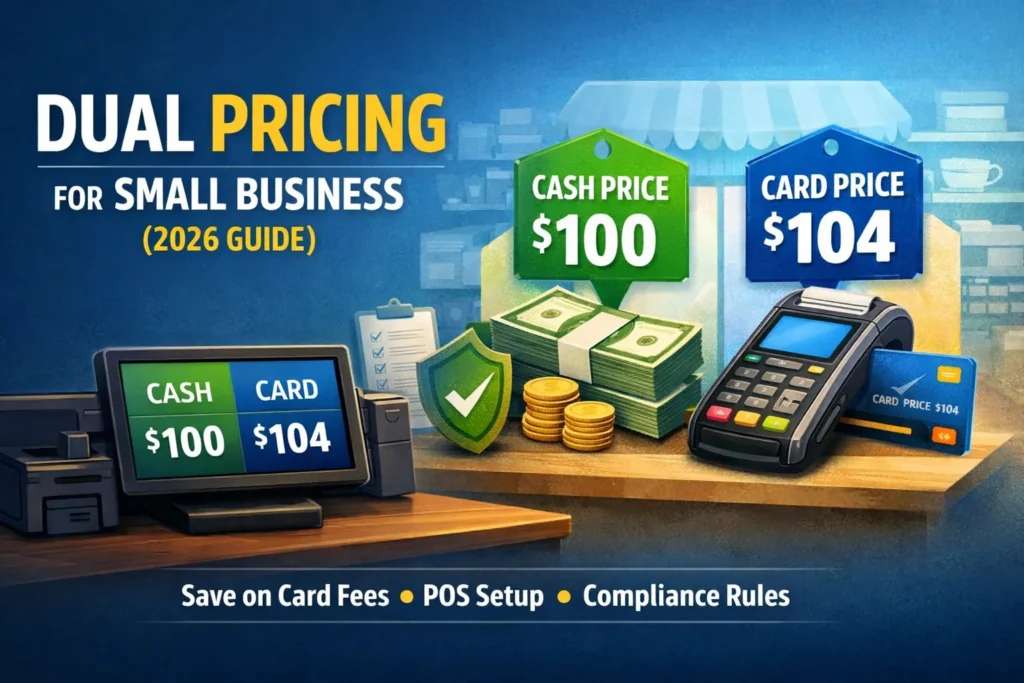
Dual pricing for small business is showing up everywhere in 2026 because small merchants are tired of watching credit card fees eat into their margins. It is simple at its core: one price for cash, another for card payments.
This is not some complicated finance trick. It is a straightforward pricing method that helps businesses stay profitable while still accepting cards without stress.
Dual pricing is now used in retail shops, cafes, salons, repair services, and almost any place where card payments are common.
And yes, this model is growing fast because people finally want clarity on where their money is going.
What Dual Pricing Really Means in Real Life
Let’s keep it simple.
Dual pricing for small business means the same product has two visible prices:
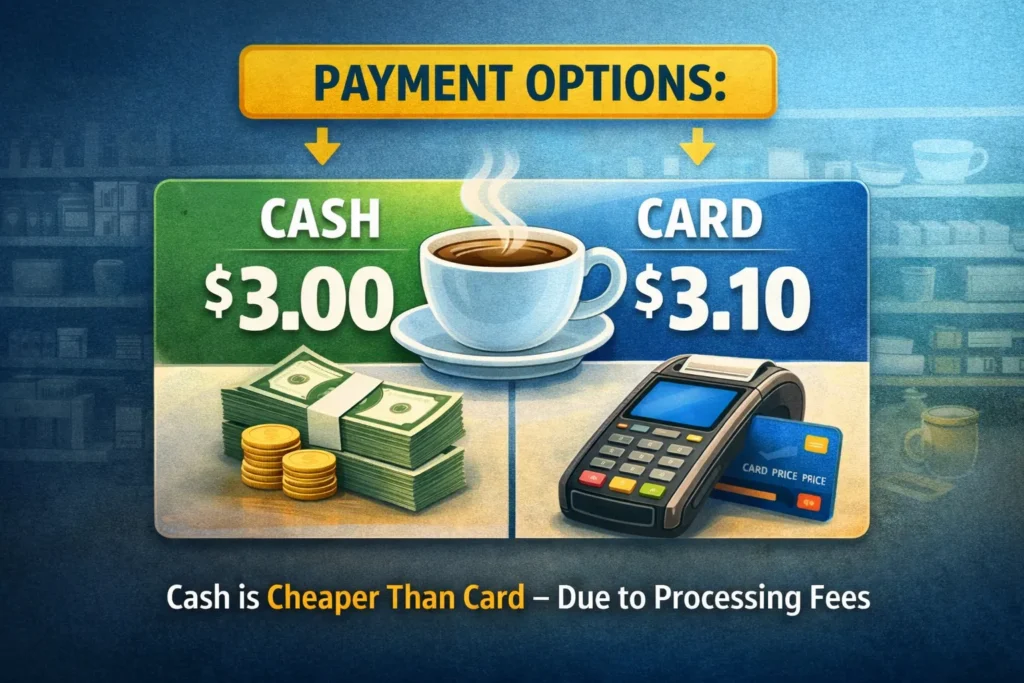
- Pay in cash → lower price
- Pay with card → slightly higher price
Nothing hidden. Nothing surprising at checkout.
It is basically saying:
If payment costs the business extra, that cost is shown clearly instead of being silently absorbed.
In real terms, it looks like this:
- A product costs 100 in cash
- The same product costs 103 or 104 on card
That difference covers processing fees.
Dual pricing for small business works best when customers understand it instantly without needing explanation.
How Dual Pricing Works Behind the Counter
In daily operations, dual pricing for small business runs through the POS system.
Here is what actually happens:
- Product is scanned or selected
- System shows cash price and card price
- Customer chooses payment method
- POS applies correct pricing automatically
- Receipt shows the breakdown clearly
No manual math. No awkward explanations every time.
Modern dual pricing setups are mostly automatic, so staff just follow the screen.
Dual Pricing POS System in Action
A dual pricing POS system is what makes everything smooth.
Think of it like the brain behind the counter.
It handles:
- Two price display system
- Instant switching based on payment type
- Tax and fee calculations
- Reporting for cash vs card sales
In real business terms, it removes confusion.
Dual pricing for small business becomes practical only when the POS system is properly set up because otherwise staff might struggle or make mistakes.
Dual Pricing Credit Card Processing Explained Simply
Here is the part most people do not think about.
Every card payment has a cost:
- Bank fee
- Card network fee
- Processor fee
This usually sits between 2% to 4%.
With dual pricing credit card processing, instead of absorbing that cost, the business adds it into the card price.
So the logic is:
- Cash = no processing cost
- Card = includes processing cost
Dual pricing for small business helps avoid that silent loss every time someone taps a card.
Dual Pricing vs Surcharge vs Cash Discount
This is where people often get confused, so here is the simple version.
- Dual pricing vs surcharge
- Dual pricing shows both prices upfront
- Surcharge adds fee only at checkout
- Dual pricing vs cash discount
- Dual pricing increases card price
- Cash discount program reduces cash price from a higher base
The big difference:
Dual pricing feels more transparent because customers see everything before paying.
No surprises. No hidden steps.
Dual Pricing Merchant Services Explained
To run dual pricing for small business, you need a payment provider that supports it.
These dual pricing merchant services usually provide:
- POS hardware setup
- Payment gateway integration
- Card processing configuration
- Compliance support
They basically set up the system so cash and card pricing runs automatically.
Without the right provider, dual pricing for small business becomes difficult to manage properly.
Why Small Businesses Are Choosing Dual Pricing
The real motivation behind it. Let’s be honest here.
Small businesses are not doing this for fun.
They are doing it because:
- Card fees are getting higher
- Profit margins are shrinking
- Every transaction matters
So dual pricing for small business helps in very practical ways:
- Keeps more profit in the business
- Encourages cash payments
- Reduces dependency on card networks
- Makes costs predictable
In simple terms, it helps businesses stop bleeding money quietly.
What Customers Actually See
From a customer perspective, dual pricing looks like:
- Two clear prices on menu or shelf
- Choice at checkout
- No hidden charges
Some customers prefer cash after seeing the difference. Others still use cards for convenience. The important part is clarity.
If dual pricing for small business is displayed properly, most customers adjust quickly.
Compliance Rules You Cannot Ignore
Dual pricing must follow clear rules in the U.S.
Here is what matters most:
- Both prices must be visible upfront
- No hidden or surprise fees
- Receipts must show payment type clearly
- Signage must be clear at point of sale
Also important:
- POS system must be compliant with card network rules
- Staff must understand how to explain pricing if asked
If dual pricing for small business is not displayed properly, it can create legal and trust issues.
How to Set It Up in a Real Business
Setting up dual pricing for small business is not complicated when broken down:
- Choose a POS system that supports dual pricing
- Set cash price and card price difference
- Connect merchant services
- Train staff on checkout flow
- Display prices clearly in store and menus
That is it.
The system does the heavy lifting once configured.
Dual pricing for small business works best when everything is consistent across digital and physical sales.
Challenges You Should Know
Even though dual pricing for small business is useful, it is not perfect.
Common issues:
- Customers asking questions at checkout
- Staff confusion if not trained
- Wrong pricing setup in POS
- Poor signage causing misunderstandings
The key challenge is communication.
If dual pricing for small business is not explained clearly, customers may feel unsure at first.
Why It Is Growing So Fast in 2026
The reason dual pricing for small business is trending is simple:
- Card usage is increasing
- Processing fees are rising
- Businesses want control again
Instead of raising product prices across the board, merchants are separating payment cost from product cost.
That is the real shift happening. Dual pricing for small businesses is becoming a standard strategy, not a niche idea.
Conclusion
Dual pricing for small business is not about charging more. It is about separating real product cost from payment processing cost so businesses stay sustainable.
When done properly with the right POS system and clear communication, it creates balance:
- Fair pricing for cash users
- Transparent pricing for card users
- Stable margins for business owners
It is simple, practical, and increasingly common in everyday commerce.
Frequently Asked Questions
What is dual pricing for small business in simple words?
dual pricing for small business means showing two prices, one for cash and one for card payments, so processing fees are clearly separated instead of being hidden in product cost.
Why do businesses use dual pricing instead of raising prices?
dual pricing for small business allows merchants to keep cash prices lower while only adding card processing costs to card payments instead of increasing prices for everyone.
Is dual pricing for small business legal everywhere?
Yes, dual pricing for small business is generally legal in the U.S. as long as both prices are clearly displayed and customers are informed before payment.
How does a dual pricing POS system work?
A dual pricing POS system automatically switches between cash and card pricing at checkout, so the correct price is applied based on the customer’s payment method.
Do customers accept dual pricing easily?
Most customers accept dual pricing for small business when pricing is clearly shown upfront and there are no surprises at checkout.
What is the difference between dual pricing and surcharge?
dual pricing for small business shows both prices before payment, while surcharge adds extra fees only when the customer chooses to pay with a card.
Can small shops use dual pricing easily?
Yes, dual pricing for small business can be set up in small shops using modern POS systems and merchant services without technical difficulty.
Does dual pricing reduce credit card fees?
Yes, dual pricing for small business shifts credit card processing costs to card-paying customers instead of the business absorbing them.
What is dual pricing credit card processing?
Dual pricing credit card processing is the method of including card processing fees in the card price so the business does not lose money on each transaction.
What is the biggest benefit of dual pricing?
The biggest benefit of dual pricing for small businesses is protecting profit margins while maintaining transparent pricing for customers.