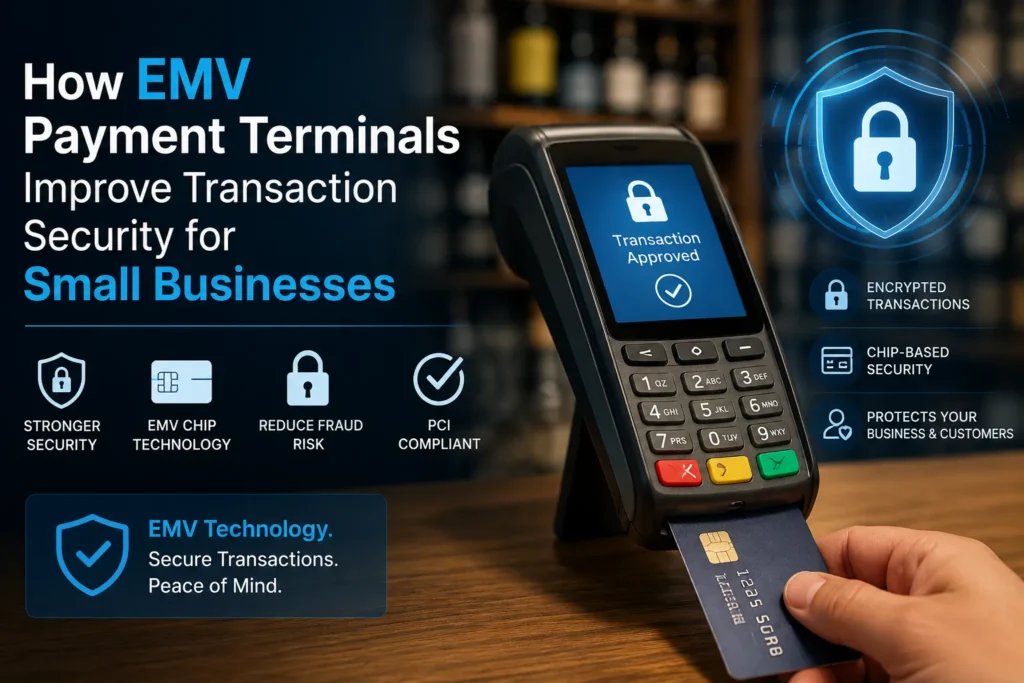
Let us talk about payment security for a moment. If you run a small business, you have probably heard about EMV terminals and chip cards. But maybe you are still using that old magnetic stripe reader because it still works and upgrading feels like an unnecessary expense. Here is the thing. That old reader could be costing you more than you realize.
An EMV terminal is not just a fancy upgrade. It is a completely different way of processing payments that actually protects your business and your customers. The technology behind it makes a real difference in keeping fraudsters away from your hard-earned money.
What Makes an EMV Terminal Different
EMV stands for Europay, Mastercard, and Visa , the three companies that looked up this global standard for chip-based payment cards. Unlike the old magnetic stripe cards that hold fixed info like your card number and expiration date, an EMV card reader reads a tiny microprocessor chip actually embedded in the card.
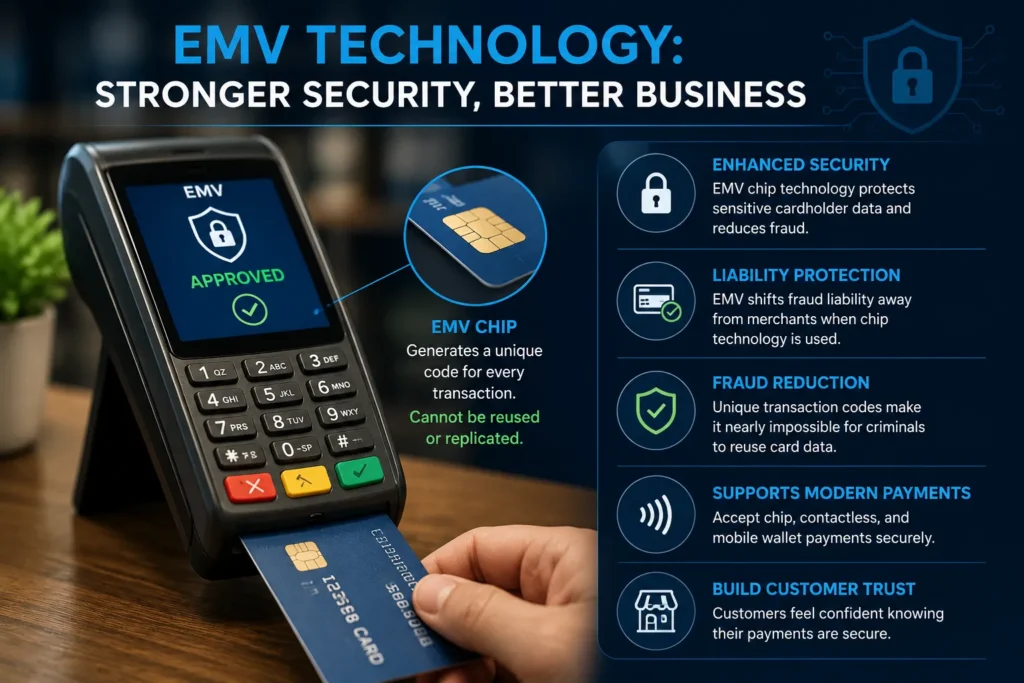
Here’s what happens when a customer uses an EMV payment terminal security. Every time the chip gets inserted, it generates a unique, one-time cryptographic code just for that transaction. That code can’t be reused. It can’t be reproduced. If a thief somehow grabs it, it’s totally useless for any future transaction.
Now compare that to a magnetic stripe. Every swipe sends the exact same string of numbers. A criminal who captures that string once can reproduce it on a blank card and use it indefinitely . That is what made skimming so profitable before chip adoption became widespread.
The Liability Shift That Matters to You
Back in October 2015, the major card networks implemented a policy change that affects every small business owner. Before this date, card issuers typically bore the cost of counterfeit fraud losses. After this date, the liability shifted. Any party in a transaction that has not adopted EMV technology is now responsible for counterfeit fraud losses that an EMV terminal would have prevented.
What does this mean for you? If you process a transaction with your old magnetic stripe reader and the card turns out to be counterfeit, you could be on the hook for that loss. Not the bank. Not the card network. You. This is a significant financial risk that many small business owners do not fully appreciate.
How Chip-and-PIN Protects You Further
An EMV terminal gives you a few ways to verify who’s actually holding the card. The most secure option is chip-and-PIN, the customer inserts the card and types in a personal identification number. That’s the standard in Europe and most of the world.
In the U.S., some terminals still use chip-and-signature, which is less secure. The customer signs a receipt, and the merchant checks it against the signature on the back of the card. But here’s the thing — a PIN is way harder to steal than a signature. That’s why chip-and-PIN offers much stronger protection.
For low-value contactless payments, many terminals do not require any verification at all to keep the checkout line moving quickly . But for larger transactions, the PIN requirement kicks in.
The Security Behind the Hardware
Modern EMV terminals come with serious security credentials. Look for devices that are PCI PTS certified, which means they meet strict security requirements set by the Payment Card Industry Security Standards Council. Many terminals also include tamper detection mechanisms that destroy sensitive data if someone tries to physically break into the device.
When you accept contactless payments, an EMV terminal uses Near Field Communication technology. This creates a short-range wireless connection between the payment device and the terminal. The communication is encrypted, and the transaction code is unique to that specific tap.
What About the Risks?
It is worth mentioning that no system is perfect. Researchers have found that the growing complexity of EMV contactless payments has created some security loopholes. In some cases, criminals can bypass safeguards or trick terminals into accepting transactions they should not.
There are also concerns about shimming attacks, where criminals insert ultra-thin devices inside card readers to capture chip data. While this stolen data cannot be used to create a duplicate chip card, it can be used to manufacture counterfeit magnetic stripe cards for use at merchants that still rely on magstripe readers.
However, the overall security of EMV chip technology remains significantly stronger than magnetic stripe technology. The industry continues to address vulnerabilities through updated standards and certification requirements.
Meeting Compliance Standards
For small businesses that operate self-service kiosks or unattended payment devices, there are additional considerations. EMVCo has specific rules for Unattended Cardholder Activated Terminals, and compliance involves more than just swapping out a card reader. The entire payment stack, including the reader, processor, application, and network, must meet certification requirements.
PCI requirements are also evolving around software-based and mobile acceptance. EMVCo is advancing both Contact and Contactless Chip Specifications with an emphasis on biometric payment cards and mobile acceptance . This means that payment hardware decisions should consider not just today’s certification status but also forward compatibility.
Frequently Asked Questions
What is an EMV terminal?
It’s the payment machine that reads chip cards and processes transactions using the EMV standard — the one Europay, Mastercard, and Visa came up with to make payments more secure.
How does an EMV terminal prevent fraud?
See, old magnetic stripe cards send the same data every single time you swipe. That’s easy to steal and reuse. But the chip inside an EMV card? It creates a brand new, one-time code for every single transaction. So even if a hacker grabs that code, it’s useless — they can’t use it again.
What is the EMV liability shift?
Since October 2015, merchants who do not use EMV technology can be held liable for counterfeit fraud losses that EMV would have prevented.
What is chip-and-PIN?
It is a verification method where the customer inserts the card and enters a personal identification number to complete the transaction .
Are contactless payments secure?
Yeah, they use encryption and generate a unique code for every single tap. That said, researchers have found some weaknesses in how these systems are actually set up.
What is PCI PTS certification?
It’s a security standard set by the Payment Card Industry Security Standards Council. EMV terminals have to meet it to prove they’re protecting payment data the right way.
Can chip cards still be hacked?
Chip technology is way more secure than the old magnetic stripe, but criminals have figured out workarounds like “shimming” to grab chip data and create counterfeit magnetic stripe cards.
What types of payments can an EMV terminal accept?
Most EMV terminals take chip cards, magnetic stripe cards, and contactless payments — including mobile wallets like Apple Pay and Google Pay.
How does an EMV terminal handle contactless payments?
It uses NFC near-field communication to talk wirelessly with the payment device. The transaction gets encrypted and gets a unique code.
Is an EMV terminal worth the investment for a small business?
Yes. The fraud liability protection and the ability to take modern payment methods make it worth it for most small businesses.