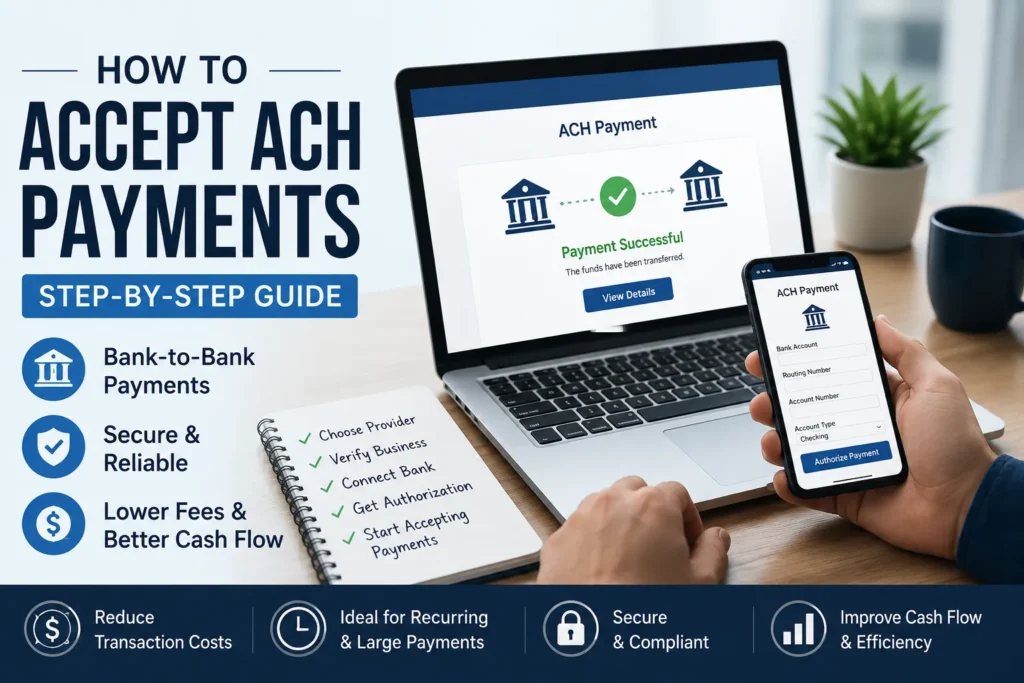
Businesses can accept ACH payments to receive money directly from customers’ bank accounts. ACH transfers can be a convenient payment option for invoices, recurring charges, and larger transactions, while potentially costing less than credit card payments.
For businesses new to electronic payments, setting up ACH can seem complicated. Understanding how ACH payments work, choosing the right payment processor, and creating a secure process can make it easier to start accepting them.
This guide explains how to accept ACH payments, what businesses need to get started, how to set up ACH payments, choose an ACH payment service, and how to receive ACH payments securely.
What are ACH Payments?
An ACH payment is an electronic bank-to-bank transfer that occurs via the Automated Clearing House. Unlike a card transaction, this type of transfer typically moves the money directly from the customer’s checking or savings account.
How Do ACH Payments Work?
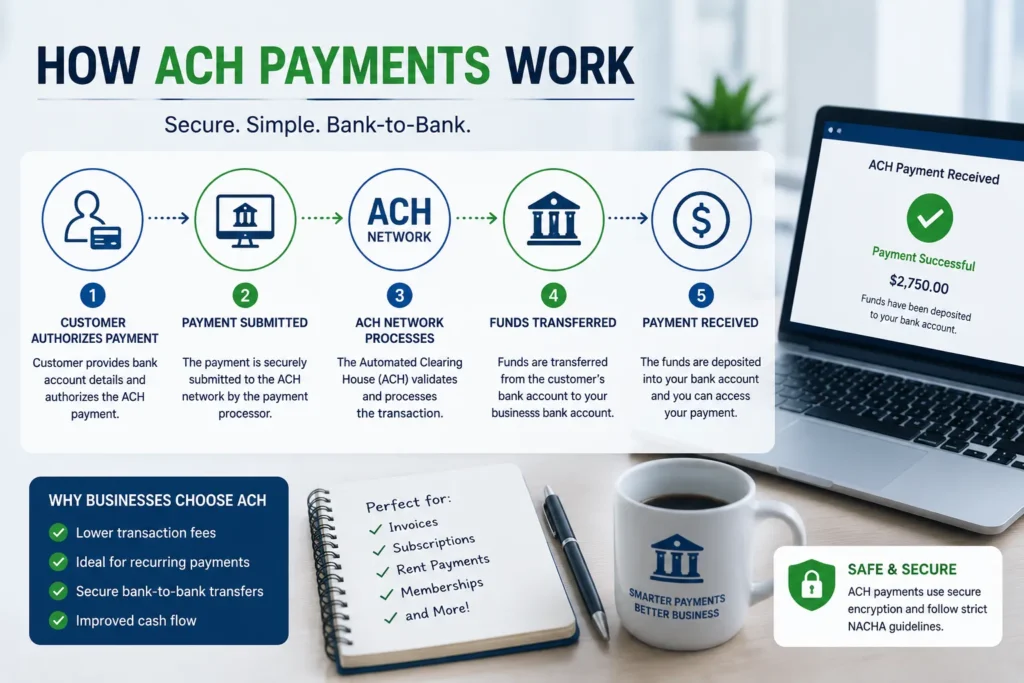
ACH payments allow customers to send money directly from their bank account to a business’s bank account through the Automated Clearing House network. The customer provides their bank details and authorizes the payment, after which the payment processor submits the transaction for processing.
Once the transaction is approved and processed, the funds are deposited into the business’s bank account. ACH payments may take longer than card payments, so businesses should check the expected processing time before marking an invoice as paid.
How to Accept ACH Payments: Step-by-Step Guide
Businesses can begin accepting ACH payments by choosing a suitable payment service and setting up their account.
1. Choose an ACH Payment Service
Learning how to accept ACH payments starts with choosing a suitable payment processor. Businesses should compare Merchant Service providers based on transaction fees, processing speed, customer support, recurring payment options, reporting, security, and other features.
A business can integrate ACH payment processing through a processor, invoicing platform, accounting software, or bank. It is essential to consider the most suitable option for the company rather than the lowest per-transaction fee.
2. Complete Business Verification
Most providers ask for the legal business name, address, tax information, and bank account details to review and approve the company’s application. A business should ensure that the documents they provide match their information to avoid complications.
3. Connect Your Business Bank Account
After a provider approves the application, the business owner must link the company’s bank account where ACH payments will be deposited. Some providers require account verification through instant verification or micro-deposits.
A company should always ensure that it is using an authorized connection rather than sharing the bank details via email. Additionally, businesses should never send customers their bank account credentials through text messages or emails.
4. Create a Customer Payment Process
A company should provide customers with a secure payment link or instructions that explain how to authorize an ACH payment. Businesses accepting payments online can also use an E-Commerce Payment Gateway to provide customers with a convenient and secure payment experience. The payment request should include essential details such as the invoice amount, due date, and available payment options.
5. Test the ACH Payment Method
Before asking clients to pay invoices through the new system, the business owner should test the process per the provider’s instructions to ensure everything works correctly. It will help the company see how authorization, processing time, and other aspects function and what they can tell their customers.
How to Receive ACH Payments Safely
The company should ensure that records of customer authorization, invoice, date of payment, and other terms of a sale are available to authorized personnel at all times. It should use secure payment links and follow the payment processor’s procedures for handling failed or pending transactions. ACH payments should not be recorded as received until the transaction is confirmed.
ACH Payments vs. Credit Card Payments
| Factor | ACH | Credit Card |
| Processing cost | Often lower | Often higher |
| Processing speed | Usually slower | Usually faster |
| Best for | Larger/recurring payments | Everyday purchases |
| Customer payment method | Bank account | Card |
| Recurring payments | Yes | Yes |
Common ACH Payment Mistakes to Avoid
One of the most common mistakes that a business can make:
- Comparing only transaction fees instead of total costs
- Failing to obtain proper customer authorization
- Not explaining processing times to customers
- Treating pending ACH payments as completed payments
- Failing to monitor returned transactions
How Much Does ACH Payment Setup Cost?
ACH payment costs depend on the service provider and pricing plans they offer. Providers offer different pricing options such as a fee per transaction, monthly subscription, or combination of both.
A company has to evaluate its average transaction size and volume to choose the most suitable option. A higher-priced option can be worthwhile for companies making larger transactions or higher transaction volumes.
When is ACH a Good Payment Option?
ACH payments are appropriate for businesses that receive payments directly from their customers’ bank accounts on a regular basis. For instance, they allow property managers to collect rent from their tenants’ bank accounts without requesting checks from them every month. ACH payments are also useful for businesses that rely on Recurring Billing, such as subscription-based companies, property managers, membership businesses, and service providers.
Businesses can offer ACH, card, and check payments to give customers more flexibility.
Conclusion
Businesses can accept ACH payments by selecting a trustworthy provider, completing verification, linking the bank account, and educating customers on the process. It is essential to compare multiple providers’ fees, security features, authorization methods, and customer support before registering.
Additionally, tracking all ACH payments on a regular basis will help organize the information and simplify the accounting process
Frequently Asked Questions
What is an ACH payment?
An ACH payment is an electronic bank-to-bank transfer that occurs via the Automated Clearing House.
How do I set up ACH payments?
Choose a provider, complete the business verification, connect your company’s bank account, create a client instructions document, and test the system.
How long does ACH take?
Depending on the provider and specific transaction, ACH payments can take different amounts of time, and a business should inform their clients about the expected duration before sending an invoice.
Can small businesses use ACH?
Yes, as ACH payments are suitable for any invoice, bill, or recurring fee.
Is ACH cheaper than cards?
ACH deposits can be cheaper than card payments, depending on a provider, transaction amount, and other factors.
Can ACH be used for recurring payments?
Yes, as Automated Clearing House transfers can be set to recur when a customer authorizes them.
Is ACH secure?
ACH can be a secure way of accepting payments through a trusted processor, customer authorization, and other precautions.
Can ACH be added to online invoices?
Yes, ACH can be used for online payments. Some invoice platforms let businesses send their clients bills with ACH as a payment option in the message.
What happens when an ACH payment fails?
If an ACH is returned, the customer will see the transaction as failed, and the payment processor should provide the return reason . If there is no explanation, the organization needs to contact their processor.
What information is needed to accept ACH payments?
Businesses typically need their legal business information, tax details, and bank account information when setting up ACH payment processing. Customers may also need to provide bank account details and authorization to complete a payment.